

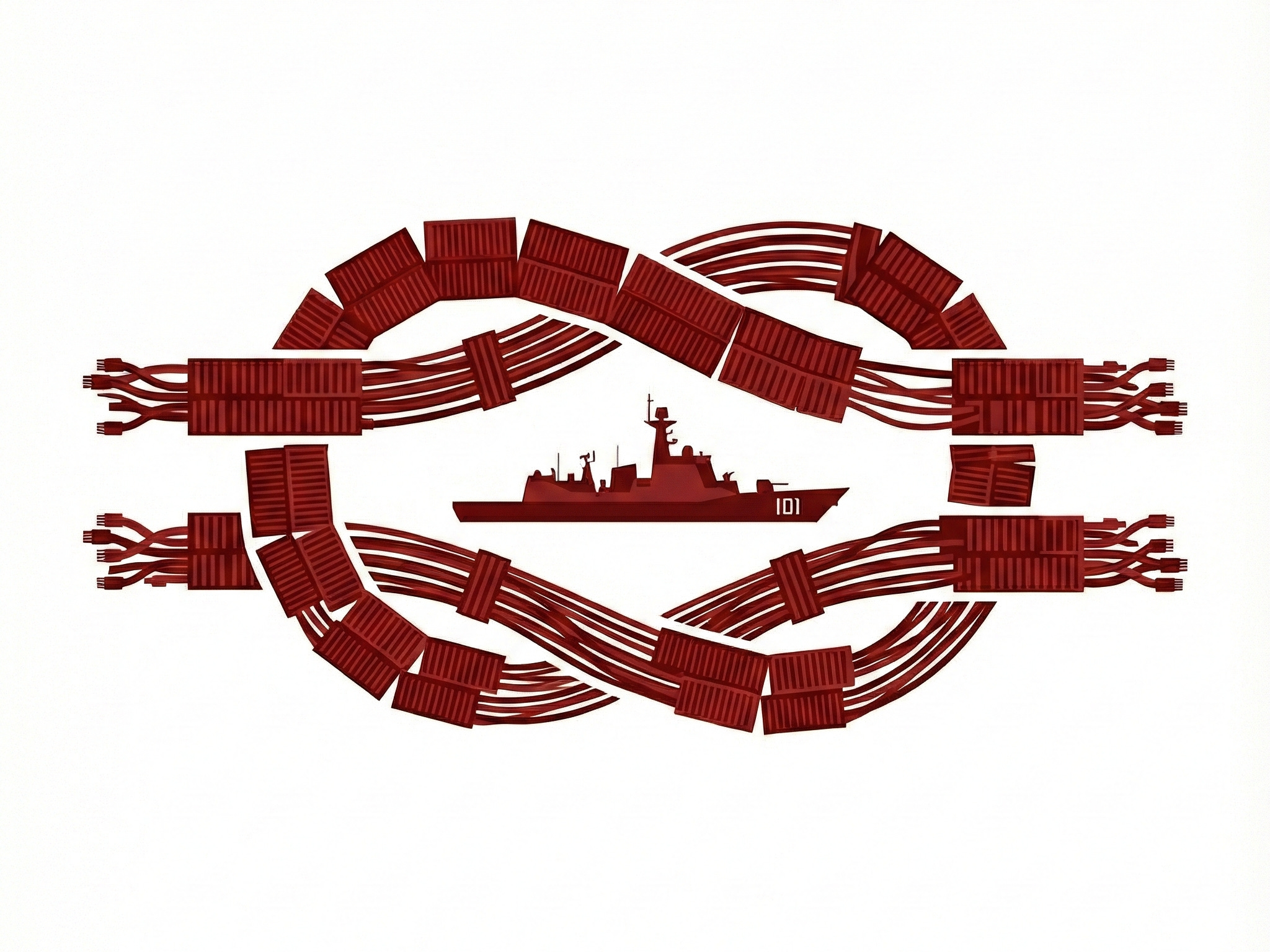
China’s military exercises around Taiwan are beginning to resemble the Fast & Furious movie franchise: Each installment carries a flashy title card and promo poster, with progressively bigger stunts and the same predictable plotline.
Beijing’s announcement on Monday that it would conduct live-fire drills across five maritime zones encircling Taiwan marks the sixth major round of PLA war games since 2022. This time, the PLA and CCG deployed 130 aircraft and 28 ships within a 24-hour period to conduct simulated blockades, testing what Beijing calls “all-dimensional deterrence outside the island chain.”
The timing and political message behind “Justice Mission-2025” were carefully calibrated. Beijing sought to needle the United States in retaliation for its December 17 arms sale, while ensuring a minimal U.S. response. To do so, it launched the exercise during a period when Washington is both distracted (during the holidays, and while the administration is squarely focused on ending the war in Ukraine) and committed to keeping the U.S.-China relationship relatively stable (ahead of Trump’s state visit to China in April). Now, propagandists are pointing to the relatively muted U.S. response as evidence of America’s lack of resolve and declining power.
We have seen this movie before. And if box office records are any indication, we’ll keep seeing it in 2026 and 2027. It’s long past time for Washington to develop a policy playbook to reestablish deterrence in the Taiwan Strait.
The Dual Purpose of China’s Military Exercises
Crafting an appropriate response to PLA exercises demands that we understand their purpose.
On the one hand, Beijing has strategic goals that have remained consistent for years — which it will not abandon, and uses military exercises to advance. These are three-fold: improving operational readiness to employ force against Taiwan, deterring foreign intervention in the event that force is deployed, and eroding Taiwan’s will to resist force applied against it.
1. Improve operational readiness by rehearsing for a genuine use of force. The Pentagon’s 2025 China Military Power Report documents the PLA’s steady progress toward its 2027 modernization goals. Each exercise validates essential components of multiple military options, including blockades, strikes against high-value targets, and the integration of Coast Guard vessels into military operations. The Eastern Theater Command clarified its most recent drills are designed to simulate a “blockade on key ports and areas,” which would deny intervention by any foreign military in the event the PLA were to employ force against Taiwan. As Admiral Samuel Paparo testified in April: “Beijing’s aggressive maneuvers around Taiwan are not just exercises — they are dress rehearsals for forced unification.”
2. Sap the political will for foreign intervention by normalizing PLA activity in the Strait. The PLA’s near-weekly joint combat patrols are designed to recalibrate what is considered “normal” activity in the Taiwan Strait. Each major, named exercise conditions both Taiwan’s public and the international community to accept intensified military activity as the new baseline. Whereas five years ago there existed a soft taboo against any PLA aircraft crossing the imagined “center-line” of the Taiwan Strait, this is today a daily occurrence. The PLA is now attempting to normalize the launch of live missiles into Taiwan’s claimed 24-nautical mile contiguous zone.
3. Erode Taiwan’s will to resist by presenting unification as inevitable. The exercises serve a psychological warfare function designed to convince Taiwan that resistance is futile and create domestic political space for accommodation with Beijing. It is no small wonder Beijing chose to time its most recent exercise to coincide with Taiwan’s legislative debate to fund a special defense budget, and on the eve of the Taipei-Shanghai Twin City Forum promoting unification.
No amount of tactical maneuvering or accommodation will force Beijing to abandon these objectives. A broad U.S. strategy for deterring future military exercises must understand this, and impose costs that make exercises less appealing or counterproductive in achieving these objectives.
On the other hand, Beijing tailors the tactical messaging around each major exercise to serve its immediate political aims — which should be actively contested. The narrative around Justice Mission 2025 served three purposes:
1. Beijing sought to reframe a long-planned exercise as retaliation for a large U.S. arms sale to Taiwan. Chinese Foreign Ministry spokesman Lin Jian framed the drill as “severe punishment for the separatist forces seeking independence” and condemned Washington for “arming Taiwan.” The drill — which came just 11 days after the arms sale announcement — was billed as an inevitable, “justified” countermeasure to U.S. “provocation.” (In reality, the December 17 arms sale was a routine implementation of U.S. policy under the Taiwan Relations Act.)
2. The exercise was timed to provoke a minimal U.S. response. Launching the drills in the midst of the holiday season ensured Washington would struggle to coordinate an immediate reply. More importantly, Beijing understands that Trump is committed to maintaining a “mutually beneficial economic relationship” with China, and so may be hesitant to jeopardize hard-won stability ahead of his state visit in April.
3. Beijing will now point to Washington’s muted response to undermine global confidence in U.S. resolve. This dovetails perfectly with the domestic political messaging of Taiwan’s opposition Kuomintang (KMT): If the United States cannot be relied upon to meaningfully respond to the largest exercises to date, what credibility do American security commitments actually carry? The PRC’s message to Taiwan is that American support is conditional and accommodation with Beijing inevitable.
It’s important to separate Beijing’s strategic goals from its tactical objectives. Again: Beijing would be conducting exercises around Taiwan regardless of U.S. arms sales or political developments. But it selected this particular timing and this particular framing, in part, to sow maximum doubt about U.S. credibility. The Trump administration’s response this week should clarify the fact that Beijing had planned to launch this exercise independent of any U.S. arms sale, that it is part of a long-running effort to normalize threatening behavior in the Taiwan Strait, and that it will play no role in influencing the rock-solid U.S.-Taiwan partnership.
A durable U.S. policy for responding to future PLA military exercises should keep Beijing’s strategic objectives in mind and attempt to deny or match them. This includes being careful with public messaging: Washington should acknowledge when exercises are happening — that they are unusual, dangerous, and destabilizing to commercial shipping — while minimizing amplification of PRC propaganda. Extensive analysis of Chinese promo material or footage captured by PLA aircraft inadvertently serves Beijing’s psychological warfare objectives by spreading the very content designed to project overwhelming force and inevitability.
Gauging Washington’s Reaction
Since 2022, U.S. diplomatic statements, follow-on arms sales, freedom of navigation operations, and reciprocal military drills have not been sufficient to deter the PLA from launching exercises around Taiwan. Several analysts point out that drawing undue attention to the PLA’s activities only risks amplifying its propaganda. This is why it is understandable — and probably the right messaging call — for the President of the United States to downplay the drills’ significance and insist he is “not worried” about them. But the reality is that the U.S. national security establishment is seized with this issue, for good reason:
Politically, each exercise contributes to the deterioration of allied confidence in U.S. security commitments in Asia. In Taiwan, a muted U.S. response to a major PLA exercise lends credence to the KMT’s argument that Washington will ultimately cut ties when the costs grow too high, and saps the Legislative Yuan’s will to fund a sufficient self-defense capability. Beyond the island, U.S. silence tells both Beijing and U.S. allies that, when forced to choose between responding to gray-zone coercion and preserving near-term diplomatic stability, Washington will choose the latter.
Operationally, holding regular live-fire exercises makes it difficult to distinguish between routine activity and preparation for a genuine employment of force. Recent exercises have featured new patterns of behavior that could mask actual preparation for a blockade or island seizure — including by simulating port closures, integrating Coast Guard and commercial vessels into operations, and declaring intent to approach within 24 nautical miles of Taiwan’s coast. As Admiral Paparo warned in February, the increased operational tempo and intensity have brought INDOPACOM “very close to that point where on a daily basis the fig leaf of an exercise could very well hide operational warning.”
How the United States Should Respond
If it wants to deter the PLA from undertaking progressively more sophisticated exercises around Taiwan, the United States must craft policies that impose real costs on Beijing without triggering an immediate crisis. Doing so will require moving beyond the standard grab-bag of ad hoc reciprocal drills, Taiwan Strait Transits, and statements of condemnation — and toward durable principles and forward-looking mechanisms to deter gray-zone coercion.
1. Reclaim the Initiative in High-Level Diplomacy with China
Beijing currently controls the tempo of escalation in the Taiwan Strait. The PLA decides when to launch exercises and how long they last. Washington’s standard-fare objections have become so predictable that Beijing has already priced them in.
The U.S.-China tactical détente engineered by President Trump has created space to invert this dynamic. Both sides have an interest in developing a more stable and predictable bilateral relationship. The administration can make clear that China’s military exercises around Taiwan directly undermine this shared objective:
A. Publicly, senior officials should indicate that sustained, productive U.S.-China diplomacy will depend on Beijing demonstrating restraint in the Taiwan Strait. This need not be inflammatory; the message can be delivered through backgrounders with appropriate outlets and comments by senior officials: “The President looks forward to productive discussions with President Xi. To ensure the best environment for that engagement, both sides should avoid actions that increase tensions in the Taiwan Strait and undermine the basis for stability in the relationship.”
The key is linking Beijing’s behavior to summit conditions, without issuing an ultimatum that destroys the political space for de-escalation. In October, when Beijing surprised the world with a sweeping rare earth licensing regime, Trump at first threatened to cancel his planned meeting with Xi Jinping in Busan, prompting an immediate walk-back. If PLA exercises continue or intensify ahead of Trump’s state visit in April, the administration should understand that the optics will not be good for the President — and the United States should be prepared to reschedule until conditions are suitable for a meeting: “President Trump does not negotiate under the shadow of a blockade.”
B. Privately, the Trump administration should demand that Beijing adhere to specific red lines. These could include:
No quarantine or interdiction of Taiwan-bound commercial traffic
No boarding or inspection of vessels in international waters
No live-fire exercises that endanger international air or sea routes
These are not naïve requests for Beijing to abandon its political objectives regarding Taiwan — they are boundaries China should have an interest in respecting, because violating them would risk internationalizing an issue Beijing prefers to frame as “internal.” The administration should communicate these red lines through appropriate diplomatic channels and make clear that crossing them would trigger immediate consequences.
2. Develop an Economic “Slipknot” That Tightens as Beijing Escalates
The United States needs a flexible, dynamic, time-bound policy tool that punishes Beijing for its transgressions — something damaging enough to change China’s calculus to conduct a given exercise, while keeping U.S. powder dry for a true emergency. The model should be a self-ratcheting instrument that tightens as Beijing lashes out, not a whack-a-mole mallet that Beijing can paint as disproportionate or escalatory.
To be credible, such a policy lever would need to be “automatic” — tied directly to the duration of Chinese military activity, extremely damaging, and within the power of the Executive Branch to start or stop at a moment’s notice. Several candidate authorities are listed below. This is meant as an illustrative exercise — any of these measures would carry significant costs for the United States, and Washington should not take them lightly. But each is severe enough that it may reasonably prompt Beijing to rethink a given exercise:
A. Suspension of flights. The no-fly zones imposed during Justice Mission 2025 disrupted travel plans for 100,000 passengers across nearly 900 commercial flights. The United States could likewise prevent Chinese carriers from overflying or landing in the United States for the duration of a given military exercise. Article 4 of the U.S.-PRC Civil Air Transport Agreement permits each party to “revoke, suspend, or … impose such conditions as it may deem necessary on the appropriate authorizations granted to a designated airline of the other Party” following consultation with the other.
B. Suspension of port calls. Depending on whether or how it is enforced, an attempted maritime interdiction campaign or “simulated blockade” of Kaohsiung and Keelung could hold international shipping at risk, destabilizing countless supply chains and causing freighters to miss their berth windows. In response, the United States could temporarily restrict maritime access by making U.S. port calls prohibitively expensive for Chinese carriers. Indeed, USTR briefly invoked this authority in October when it imposed fees of $50 per net ton, per port call on Chinese-operated vessels. For a carrier like COSCO, which makes thousands of U.S. calls annually, this was effectively a suspension of service rights.
C. Pause on visa processing. For the duration of a given exercise, the United States could temporarily slow or suspend the processing of non-immigrant Chinese visa applications — either through administrative policy changes that redirect or restrict where NIV applications can be adjudicated; or through a temporary suspension of routine visa services at specific diplomatic posts within China. The Trump administration most recently announced such a measure in August during diplomatic negotiations with Zimbabwe.
D. Temporary tariff surcharge. Trump has already demonstrated he is willing to use tariffs as diplomatic leverage, most famously through the 20 percent fentanyl surcharge that brought Beijing to negotiations in Busan. It might not be such a far cry to imagine a similarly structured “Instability Fee” — a temporary, targeted 10-15 percent tariff increase that lasts for the duration of a military exercise, increasing or sunsetting depending on Beijing’s compliance.
Regardless of what form it takes, an economic slipknot — declared in advance, with specific start and end conditions pegged to truly destabilizing PLA activity — would demonstrate resolve without risking drastic escalation. It would bolster deterrence by imposing a predictable cost for Beijing, and give the administration a tool that can be calibrated to the severity of a given exercise.
Moreover, adopting such a consistent, “automatic” mode of cost imposition would preserve space for continued U.S.-China diplomacy — by making clear that U.S. pressure is tied to specific Chinese behavior that threatens regional stability, not general opposition to U.S.-China engagement or the wider project of developing a mutually beneficial economic relationship with Beijing.
3. Expedite Arms Sales Commensurate with the Threat Taiwan Faces
Beijing’s decision to cast its military exercises as “punishment” for U.S.-Taiwan defense cooperation cannot stand unchallenged. If China succeeds in establishing a DARVO pattern whereby it lashes out in a military exercise, blames the arms sale for provoking it, and then the world watches Washington hesitate to provide Taiwan with weapons next time, we risk effectively handing China a veto over Taiwan’s self-defense capability.
The administration should proceed with concrete measures that ensure any given PLA exercise backfires by enhancing Taiwan’s readiness more than Beijing’s.
A. First, the United States should design a policy framework whereby PLA exercises trigger expedited provision of existing arms sales to Taiwan. This will require addressing structural bottlenecks in the Foreign Military Sales (FMS) process.
The reasons for the $22 billion backlog in U.S. arms sales to Taiwan are well-documented: Each sale is subject to a review of U.S. production capacity, and added to a queue that prioritizes active-duty U.S. forces over foreign partners. Many obstacles in the FMS process are technically or politically impractical to address — Lockheed Martin cannot manufacture additional Precision Strike Missiles overnight while domestic demand exceeds production capacity. But at least some of Taiwan’s 25 ongoing FMS cases face hurdles that are largely procedural, owing to bundling and de-prioritization in the procurement queue, and could be compressed with senior-level attention and clear guidance.
One option would be to allow the Under Secretary of War for Acquisition & Sustainment, in coordination with DSCA and INDOPACOM, to issue guidance temporarily designating Taiwan as a “priority customer” for select systems following major PLA drills. This could be executed through a Defense Priorities and Allocations System (DPAS) adjustment or internal DSCA directive to move up a certain number of Taiwan’s orders within the existing “DO-rated” industrial queue, effectively slotting them alongside or immediately behind “DX” U.S. Service requirements, rather than at the end of the international line.
The guidance could be time-bound (e.g., boosting new orders placed within 90 days of a PLA exercise) — and applied selectively to cases where production capacity exists but delivery timelines are artificially long; where the sale contributes immediately to cross-Strait deterrence (e.g., Harpoon, Stinger, Javelin, HIMARS); and where Taiwan’s Defense Ministry can demonstrate the ability to immediately receive and operationalize the system.
This mechanism would signal to Beijing that conducting coercive drills will accelerate Taiwan’s readiness rather than intimidate it. And it is fully consistent with the longstanding U.S. one China policy — which assists Taiwan with maintaining a sufficient self-defense capability that is “commensurate with the threat it faces.”
B. Second, if Beijing’s coercion escalates beyond exercises into actual maritime interdiction, the United States should prepare options for transfers of additional munitions to Taiwan using Presidential Drawdown Authority (PDA).
The Trump administration is understandably hesitant to give away precious stockpiles of U.S. munitions when domestic requirements remain unmet and the United States faces crunches in production capacity across multiple munitions categories. But China’s military exercises against Taiwan are a special case — they are expressly designed to place a ceiling on U.S.-Taiwan coordination and erode global trust in American resolve. This is precisely the scenario that Presidential Drawdown Authority was created to address.
The goal should be to lean on PDA to deter destabilizing Chinese behavior, not necessarily facilitate the immediate drawdown of U.S. stockpiles. The Trump administration should develop packages, obtain necessary approvals, and communicate through appropriate channels that these options exist and will be invoked if Beijing crosses established red lines.
A coherent, consistent U.S. posture could invoke an economic slipknot in response to a major PLA exercise, with the promise of immediate defensive arms transfers from U.S. stocks if the exercise escalates into actual interdiction or poses a threat to international commerce.
Deterrence That Advances Diplomacy
The President’s April summit will be more productive if Beijing understands that coercion carries costs. The policy tools outlined here are designed to impose that cost in a way that is predictable, reversible, and advances the longstanding U.S. objective of maintaining peace and stability in the Taiwan Strait.
This framework also leaves room for the mutually beneficial bilateral relationship both Washington and Beijing claim to want. It does not pretend that China will abandon its political objective of unification, nor does it require taking a position on Taiwan’s ultimate political status. It simply makes clear that productive U.S.-China relations require mutual restraint in the Taiwan Strait — and that restraint will be rewarded while coercion will not.
A successful U.S. strategy for managing PLA exercises will not eliminate them as a feature of Chinese foreign policy — they are too essential to Beijing’s defense modernization for this to be a realistic U.S. objective. Rather, the goal should be to narrow the scope of what Beijing believes it can do without consequence, deter activities that hold international commerce at risk, and ensure that each drill strengthens rather than erodes Taiwan’s capability and willingness to defend itself.
The alternative is to wait until a simulated blockade becomes reality, and for all parties to discover what red lines exist only after they’ve been crossed.
Valuable insights here in this piece, well done! Currently, Beijing believes it can push/test the limit of coercion by force without consequence. A tempered whilst unambiguous response from Washington against these activities is sorely needed, sooner rather than later.
A really excellent article with razor sharp analysis that doesn’t just diagnose the problem but offers crystal clear answers. Well done and thank you! I would be fascinated to know what role you think other nations could/should play. Avoiding conflict in the region is in (almost) every major economy’s interest, and this can’t just be a problem owned by the US right? EU of course doesn’t have the same literal firepower as the US but could and should it impose serious costs?