

Most white-collar professionals I know are using AI incorrectly.
Because white papers, reports, and press materials are still the coin of the realm for knowledge work, many people are applying AI narrowly—to help with specific steps in producing their next individual piece of content.
For example, a research assistant might query a chatbot for an answer to a specific historical question, track down a piece of data, or find an appropriate citation to weave into a report; or a marketing director might use AI to generate the first cut of a press release.
I don’t believe this is going to remain tenable for much longer. I would say Astra 6 and Fable 5.1 are nearly as capable as I am at producing frontier knowledge-work. We are at a point now where a single well-crafted prompt can elicit a detailed, coherent, 20-page report that exceeds the quality of what a human consultant could produce over several weeks.
Rather than throw up my hands in dismay at my personal inability to compete with AI, I have spent 2026 adapting to what I believe will become a norm for white-collar work: using AI to build systems and tools that assist with the mass-production and assortment of knowledge in my particular domain expertise.
The result has been a transformation of my professional identity: From writer-and-analyst to founder-and-engineer of autonomous institutions that run themselves.
The process is not linear, and for “non-technical” people, it can at first seem overwhelming. Here is what I have learned so far:
Writing Problems are Engineering Problems
The first, most momentous step on the path from being a “creative” to becoming an “engineer” is to think one level of abstraction above your immediate task.
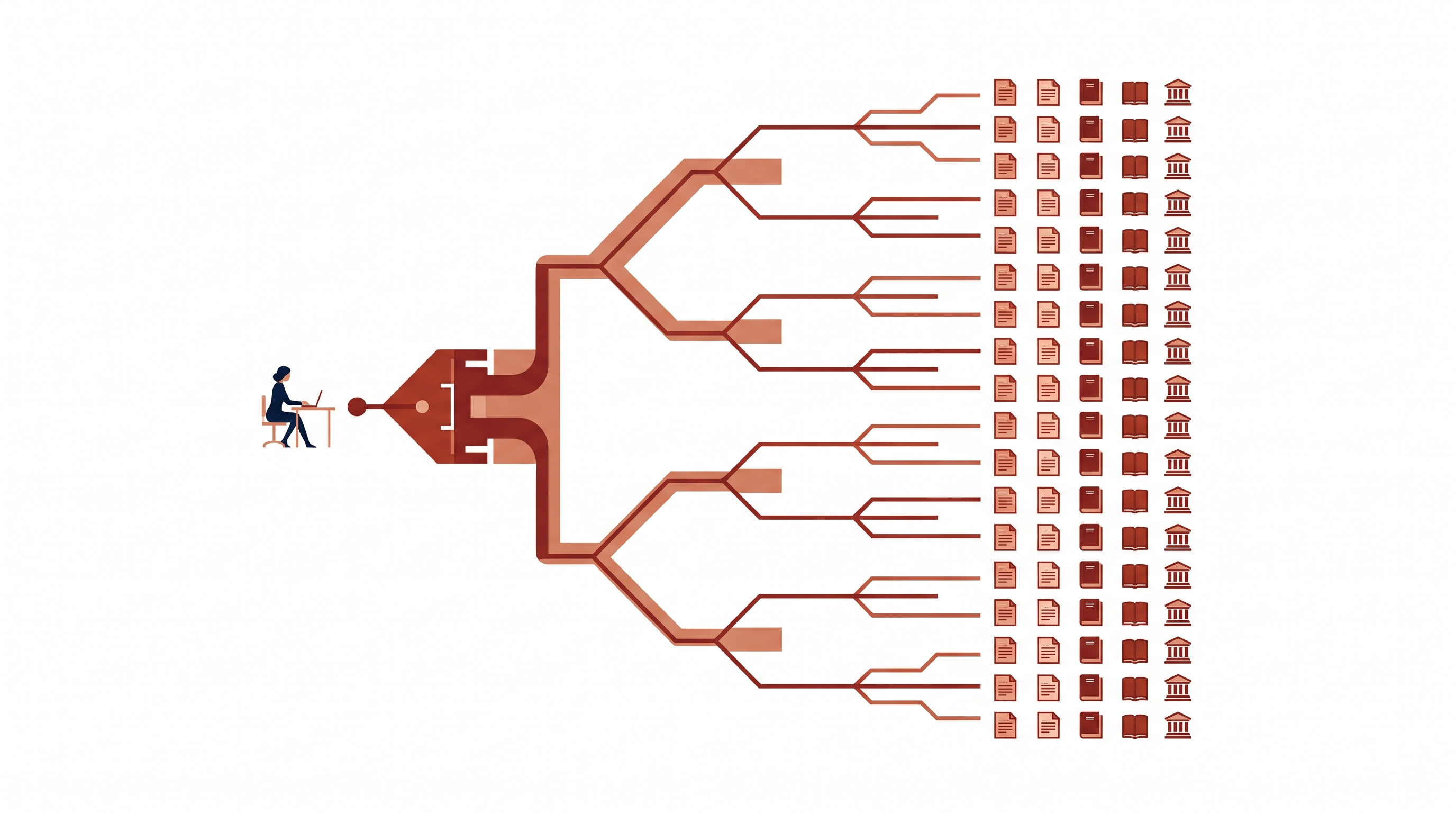
This requires transforming individual judgments about creating a piece of content—for example, how best to refine an individual essay—into durable software engineering and product decisions that will be useful in continuously generating thousands more versions of the same.
Here are a few examples of what I’m talking about:
Software that writes diplomatic cables.
As a desk officer at the State Department, my job was to summarize meeting transcripts and news about world events into diplomatic cables. This required being a good analyst and writer—I had to process an onslaught of data and information, and hammer it into usable one- and two-page informational products for busy executives.
A “normal” use of AI in this situation might have been to help reformat my cable, add transitions between paragraphs, or track down a particular fact. Instead, in March 2026, I asked: How can I train an AI to reliably generate a diplomatic cable in my writing style—and make the same analytic judgments I would—when given a particular set of input data? Effectively, how can I automate my own job?
The result was Digital Embassy, an autonomous intelligence service reading 25,000 news stories and publishing 22 diplomatic cables each day.
Software that conducts forensic investigations.
In my class at Georgetown on intelligence analysis, I spend a week teaching about cryptocurrency investigations. We begin by explaining what blockchain is, why crypto exists, how to create a wallet, and what public records are created when you transact with it. I buy some Bitcoin live in class. Then I teach the students how to manually trace some wallet addresses used by ISIS back to a popular crypto exchange.
This kind of analysis is very cumbersome; it requires inspecting a huge number of transactions and examining particularly large or suspicious ones. A “normal” application of AI could involve typing a wallet address into Claude and asking it to conduct the investigation for us—but why stop there? Instead, we explained to Claude our own basic investigations workflow, and asked it to create software capable of conducting an investigation systematically when given any wallet address as an input.
Within 40 minutes, it had generated a primitive version of Chainalysis’ Reactor, which normally runs at least $15,000/seat.
Software that combs through research archives.
Many social scientists perform archival research to help us understand decisionmaking at important moments in history. AI is particularly good at scouring archives and reassembling primary source documents in a digestible format. For example, I could have very easily asked ChatGPT to prepare a detailed biography of Anatoly Dobrynin, the Soviet Union’s longest-serving ambassador to the United States.
Instead, I spent weeks iterating in a ChatGPT project to establish rules to guide my AI’s research, sourcing, and writing quality—and applied those rules to mass-produce (and fact-check) biographies of every ambassador.
The result is “Diplopedia”—an online encyclopedia covering the lives of 2,000+ ambassadors who have ever served in Washington.
In each of these three cases, I moved beyond the task at hand to instead think about how it could be systematically automated.
My personal taste, analytic rigor, and domain expertise remain an essential part of each product. If you read Digital Embassy cables or Diplopedia articles, you can tell this is not run-of-the-mill AI slop. Rather than apply my judgment to write a single cable, conduct a crypto investigation, or compile a biography, I have distilled my judgment into an explicit system of rules to govern the autonomous production of content at scale.
The point is to produce vast quantities of high-quality content that is delightful and information-rich for humans—and, increasingly, for AIs—to consume.
Why vast quantities? While the shape of the future is still a little hazy, I believe this is the direction of knowledge-work after AI: intellectuals relying on teams of agents to aim, modulate, and consume spigots of information at superhuman scale and speed.
The economics of producing and consuming knowledge are changing in tandem. As AI makes it cheaper to research, synthesize, and publish information, it also enables people to make sense of far more material than they could ever read for themselves.
This changes the audience for our work. Increasingly, we must think of AI agents as the audience for our work—not just as tools for producing it. Bots already account for an estimated 57 percent of global internet traffic. And as personal agents become more capable, a growing share of research and information discovery will be mediated by AI.
In this environment, scale can become one source of advantage—as a larger, well-organized, continuously updated body of reliable knowledge creates more opportunities to be discovered and used. In the late 2020s, many knowledge-workers may be tempted to build a personal, intellectual firehose embedded with their taste and judgment.
The Lifelong Process of Becoming Technical
Moving from “creative” to “engineer” doesn’t have to be complicated, though it can at first seem overwhelming.
My advice is simple: Just let your curiosity get the better of you, and enjoy slipping slowly into a warm bath of technical knowledge.
Through constant iteration and exposure to new problems, you will be invited to venture down a labyrinth of rabbit holes on technology, the structure of the internet, and the nature of online commerce.
Your journey will at times feel frustrating. But in overcoming that friction, you will feel an addictive sense of accomplishment. And LLMs have become incredible tutors at each step of the way.
1. Build something that works.
Your first, most basic task is to work with an LLM to build a simple piece of software: a system that takes information as an input, and produces knowledge as an output.
The hardest step in this process is the first one: articulating in plain English what, exactly, you want your program to do. A good prompt requires decomposing your problem into smaller steps, and specifying what you want from your software—how you want the output writing to sound, how the interface should feel.
Your first-ever program will run as an executable file on your own computer (“localhost”)—probably something that opens in your web browser.
After you have a working prototype, you can worry about modifying it: fixing bugs, tweaking the interface, adding features. “Do this, not that.” You’ll start to build out a sort of instruction manual.
2. Make it reliable.
You can get pretty far uploading and downloading .zip folders of your project’s V1, V2, V3 code (and related instruction) in ChatGPT.
But eventually the file management gets unwieldy. You will learn about code management and Git. You’ll create a Github account and connect it to your LLM. You’ll learn what an API is, and spend your first $25 on credits.
You’ll also learn how to work better with LLMs. You’ll train them to create /skills for repetitive processes. You’ll create detailed project instructions and product specifications. You’ll surpass your first 10 million tokens. You’ll learn about usage limits and develop an intuitive feel for token consumption.
You’ll learn about tool use. About agents, about their harnesses and command line interfaces (CLI). About Claude Code and Codex. You’ll learn how agents navigate the web—about web scraping, and Playwright.
3. Put it on the internet.
Eventually you’ll want to share your creation with the world.
You’ll look into how to host your program on someone else’s server, rather than your own computer. You’ll learn about the kinds of processors available to you—about CPU power, about memory. About geographic latency. You’ll develop an intuitive feel for how much space a Gigabyte really is. You’ll rent a domain name and learn about DNS.
You’ll learn how to push code remotely to your virtual private server (VPS). How to create a Github pull request, how to set up Tailscale, how to SSH into your server.
You’ll learn about security—if not by design, then from experience. You’ll learn about proxies. About Cloudflare. Containerization with Docker. About key and secret management.
You’ll learn how web pages work—about HTTP, CSS, and Javascript. You can go a long time without really knowing about Javascript. Until you wonder why your amazing interactive dashboard won’t show up on Google.
You’ll learn about SEO. About backlinks. About Google developer tools and sitemaps.
4. Make it good.
Once you’ve built and deployed your project, you’ll start to gain an appreciation for all the work that went into others.
You’ll wonder how the other developers make their projects so smooth, so clean, so fast. You’ll begin to recognize AI-generated sites—and be horrified at the tell-tale signs in yours.
You’ll get curious about design. You’ll learn about React. About Figma. You’ll learn about libraries like UseLayouts—about hero pages and footers and Apple’s design principles.
You’ll get really, really good at recognizing AI-generated writing. This trained disgust will make you better at editing. You’ll become obsessed with refining your slop cannon to generate prose that delights.
You’ll start coming up with boundless more product ideas—for new features, spinoff verticals. Your project can have its own Substack, with a changelog and developer blog. Automated socials. A mobile app.
With all these new features, you’ll need to separate staging from production. Despite your best efforts, you’ll break prod. At first it won’t matter—and then, it will.
You’ll process your first billion tokens. You’ll curse the frontier labs for their weekly usage caps. Your $25 token spend will climb to hundreds, or a thousand. You’ll consider buying your own server to conduct local inference with open weights.
You’ll adopt program management principles to ship features fast and fix bugs. You’ll learn what all those tech company PMs actually do all day, and—hey, shouldn’t you start logging all these “to fix” issues in a Jira board?
You’ll solicit feedback as your readers become your users.
But what to do with it all?
5. Make it autonomous.
By now, you are a founder. You revel in the newfound clarity that it’s time to build. But you’re still spending a lot of time telling your AI what to do.
In making the shift from content-producer to systems-engineer, you’ve also radically increased the marginal value of one hour of your time. The opportunity cost of your attention skyrockets.
Now you need to protect it—by making yourself less necessary.
It starts with automating away repetitive tasks like patching, marketing, and finance. You’ll learn how to schedule agents to perform tasks unprompted.
Eventually, you’ll begin delegating not just individual tasks, but entire projects. You’ll find yourself managing teams of agents, just as you might manage a team of human researchers or engineers. You’ll find ways to give them context knowledge to make them world-class at their respective jobs.
You’ll discover that all this autonomy creates its own problems. Agents get stuck and misunderstand instructions. They spend hours trapped in loops doing dead-end work that will be thrown away. They confidently report having completed work they haven’t actually finished.
You’ll learn to demand evidence, build monitoring systems, and make sure important decisions still pass through you. You will learn the difficult art of being not just a founder, but a CEO.
At some point, you’ll realize your individual pieces of software are interacting with each other—with workflows, standards, and a growing body of esoteric knowledge.
You now run a one-person institution.
The New Bottleneck Is Judgment
The cost of generating knowledge has cratered and slop is flooding the internet.
In this environment, owning your own cannon is not enough. Filtering will matter more than ever. Generated output must be trustworthy, accurate, and genuinely useful to an audience—not mountains of unread .html.
Return to our diplomatic encyclopedia. It is one thing to task an AI with writing a thousand biographies. It is another to build a system that is capable of discerning trustworthy historical sources, how to reconcile contradictory accounts and uncertain claims, and which details are salacious or interesting enough to make a biography worth reading. These are editorial decisions—encoded by the creative mind, backed by domain expertise. But increasingly, they must be expressed as product engineering requirements.
The difference between a one-person institution and the industrial-scale production of garbage rests on the quality of human judgment encoded into a system.
In the final analysis, the ultimate test for the writer is the same as it always has been for the founder-engineer:
Can you make something people want?
Very well done, Ryan!
"in March 2026, I asked: How can I train an AI to reliably generate a diplomatic cable in my writing style—and make the same analytic judgments I would—when given a particular set of input data? Effectively, how can I automate my own job?"
Could you explain what you mean by "train" here? Did you actually use an optimizer to update a model's weights?
I'm not saying this is your case, but I've been running into a lot of non-technical people claiming to train AI, and it usually turns out they're just. . . conversing with it. Sometimes they have created a few documented practices, which are better referred to as harnesses or skills.
This is an important distinction, because if they learned what training actually is, it would open up a whole new frontier of possibilities for effective automation and improved task performance.
It's also an important distinction because using terms erroneously can destroy credibility. Imagine mixing up Kazakhstan and Kyrgyzstan!
With that out of the way, thanks for the piece. It's pretty clear that the forms of knowledge-production are going to evolve rapidly in the next few years.