

For the past several months, Satvik Pendyala and I have been buried in wafer allocation tables, yield rate estimates, and thermal design specifications, trying to answer one of the most important questions now facing the United States:
When will China be able to make its own AI chips at scale?
Our answer, published this week in a new report for the American Enterprise Institute, is sooner than many analysts had thought. By our estimates, Huawei could meet half of China’s domestic compute demand as soon as 2028, with full self-sufficiency becoming thinkable by 2030. If that projection holds, it will have permanent consequences for the U.S.-China competition to deploy AI services.
The time to prepare is now.
It’s the Compute, Stupid
The AI race is no longer principally a race to train frontier models; it has become an industrial systems competition. In 2026, the binding constraint on AI as an instrument of national power is not producing a marginally smarter model, but serving intelligence—continuously and profitably—to billions of daily active users. This requires vast fleets of AI accelerators and the energy infrastructure to power them.
To measure the most acute gap in AI deployment today, we introduce a new metric, Annual Energizable Compute (AEC)—the installable, power-drawing potential of a year’s worth of AI chip production, denominated in gigawatts (GW).
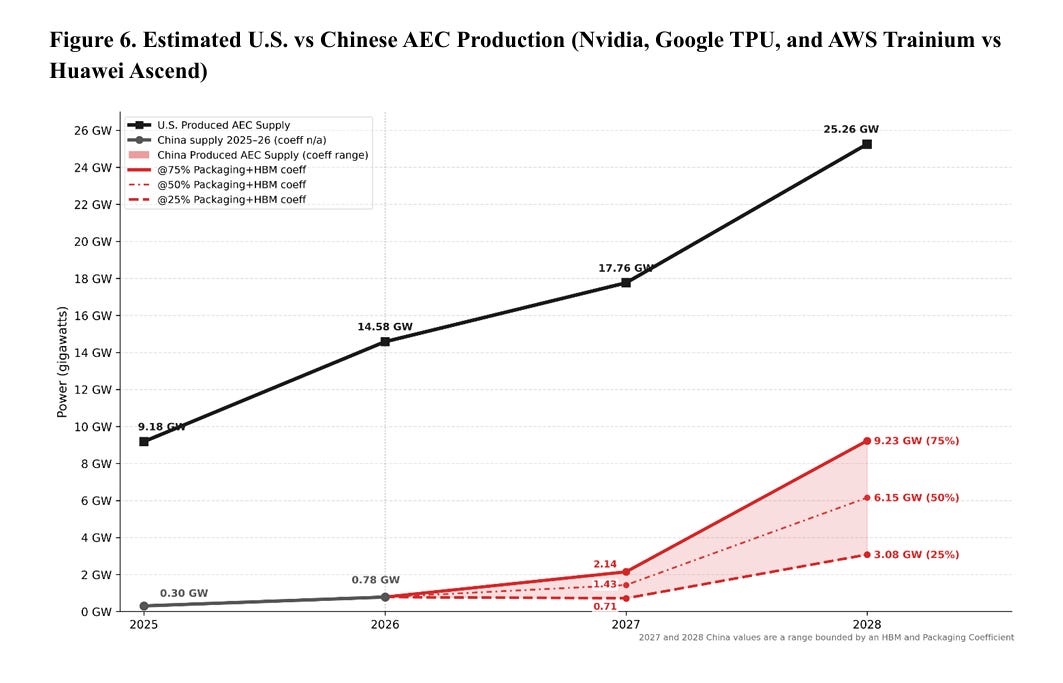
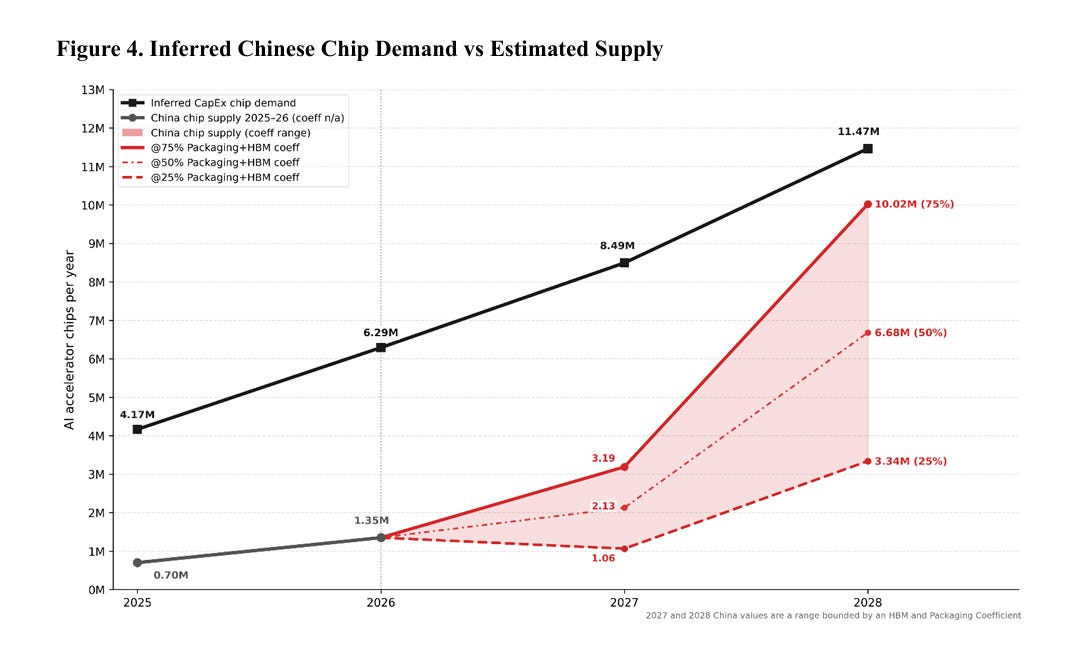
Measured this way, the United States holds commanding advantage: China still struggles to make AI accelerators at scale. In 2026, we project the United States’ largest AI chip design companies (Nvidia, Google, and Amazon) will produce 20 times more power-drawing silicon than China’s Huawei. Put another way, Huawei will be capable of supplying perhaps one fifth of the compute demanded by China’s AI labs and hyperscalers, while everything else must be smuggled, stockpiled, or otherwise negotiated with the Trump administration for access.
What the Numbers Show
America’s monopoly over compute production is quickly depreciating. By 2028, our end-to-end model of China’s chip supply chain suggests Huawei is on track to produce 3.3 million Ascend-series accelerators, capable of drawing a collective three gigawatts of continuous power. That is double the number it will produce in 2026, and the true figure could be much higher, depending on the construction speed of China’s memory and chip packaging facilities.
Our fifty-page report models China’s remaining chipmaking constraints in intricate detail. It’s worth knowing a few of these key variables—which account for most of the uncertainty in our analysis:
1. The first variable is improving yield rates for logic chips, which are currently reported around 40 percent for Huawei’s latest-generation Ascend 950 and could plausibly reach 60 percent by 2028. Some industry analysts remain skeptical of these claims. Technical teardowns of Huawei 910C chips have shown the company remains dependent on a bank of die originally fabricated by Taiwan’s TSMC—Chinese chipmakers’ actual yield rates are the subject of intense debate.
2. The second variable is logic wafer allocation. SMIC has already achieved 7nm-class fabrication at significant volume; it has simply been using that capacity to make smartphone processors rather than AI accelerators. As yields improve and accelerator demand explodes, SMIC could choose to make fewer chips for phones and more for server racks. The single most important variable in our model is how quickly SMIC shifts its leading-edge capacity from Kirin-class chips to Ascends (which currently account for 9% of its N+2 and N+3 wafer capacity).
3. The third variable is memory and packaging, which remain China’s most acute bottlenecks. China’s memory champion, CXMT, cannot yet produce enough high-bandwidth memory to pair with the logic die SMIC will fabricate over the next few years, nor can packaging houses like TongFu Microelectronics assemble them all into finished accelerators. Because so much about these industries is uncertain, we model three scenarios in which China sources enough memory and packaging to complete 25, 50, or 75 percent of its logic die.
No matter how we slice the data, we find that China is well on its way to producing large quantities of AI accelerators. In even our most pessimistic scenario, Huawei could meet a third of China’s compute demand by 2028. If memory and packaging ramp fast, and if Huawei slides over more of its production from smartphones, this figure could climb north of 50 percent.
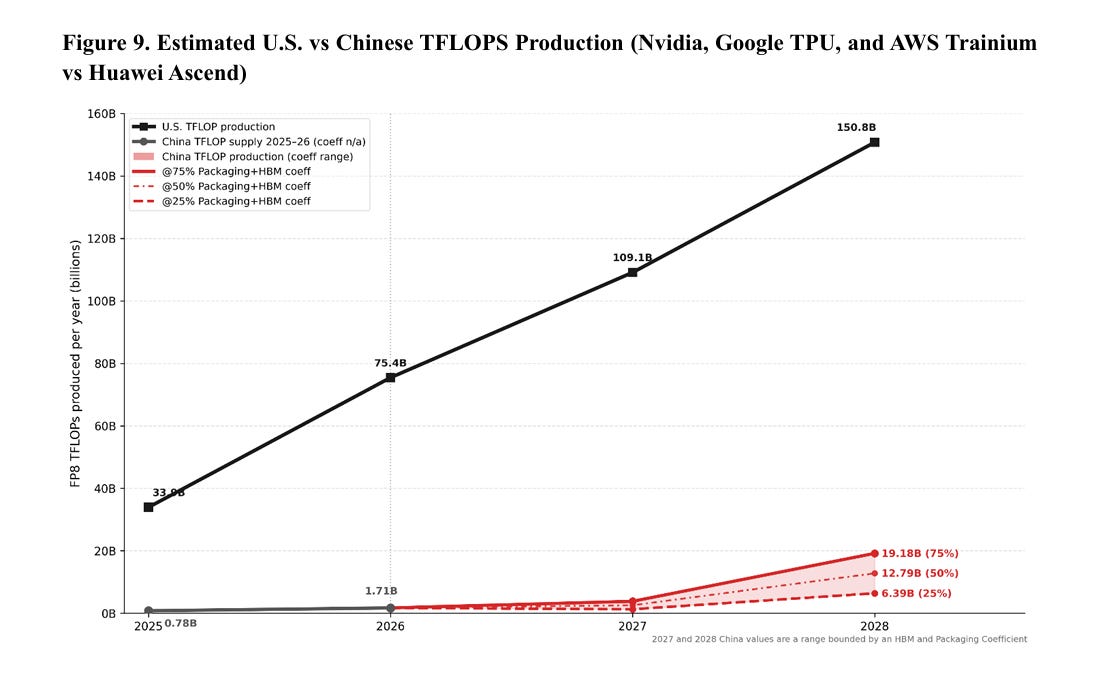
There is one important caveat to our analysis: Chinese chips remain extremely power-inefficient. Converted to raw computational performance (FLOPS), American hardware retains a nine-to-one lead that is unlikely to narrow for the next several years. We lay out in the report why this matters for American strategy: much of the world faces aging energy infrastructure, and so the cost of installing power-hungry Chinese compute is much higher by comparison.
The bottom line is that China is not about to out-compute the United States, but it might soon stop needing American compute quite so badly. And shortly thereafter, we should expect it to start competing with U.S. hyperscalers to build the foundations of the global intelligence economy.
How to Cement American Power
For now, the United States is the world’s sole provider of AI compute, and compute is a seller’s market. Washington can attach strings, demand investment packages, and require countries to rip out Chinese network equipment in exchange for frontier chip access. I have written before about the wisdom of this “compute diplomacy.” But with cheap Chinese compute coming soon, the kinds of deals that were once available to the Trump administration in 2025 and 2026 will not be so attractive to other countries forever. The task now before Congress and the administration is to convert a depreciating technical advantage into an appreciating structural one.
Our report recommends four measures to cement American power during this crucial period of the global AI build-out:
1. Widen the window. Enacting and maintaining stringent export controls on semiconductor manufacturing equipment can delay China’s production of logic die, memory, and packaging capacity—blunting its total compute production for longer. Cutting off access to lithography machines and preventing Chinese AI labs from renting foreign servers should remain top policy priorities.
2. Negotiate strategic compute partnerships with power-rich countries now, before China’s chip production comes online. The goal should be to install American chips-in-sockets, especially in markets that are poised to grow. Our report reflects on lessons learned from the deals struck with the UAE and Malaysia, which could serve as templates for future agreements.
3. Preempt China’s predatory financing with American AI infrastructure diplomacy. A strengthened Development Finance Corporation and EXIM Bank could offer full-stack AI packages that lock in U.S. tech platforms for generations. DFC is already working hand-in-glove with the State Department on the American AI Exports Program.
4. Fund intelligence on China’s semiconductor ecosystem. While Satvik and I have tried our best, tracking China’s computing breakthroughs cannot fall to a few enterprising technology analysts. Congress must supply the intelligence community with adequate resources to keep tabs on one of the world’s most important and fast-moving industries. A public-facing “China Tech Power Report,” modeled on the Defense Intelligence Agency’s China Military Power Report, could help remedy the situation.
Our modeling is more optimistic about Chinese capabilities than many other technology analysts currently predict, and we expect plenty of disagreement. Good. The current state of public knowledge about China’s chipmaking trajectory is not adequate for the decisions being stacked on top of it, and we hope this report opens a much wider conversation on how best to prepare for a China that is no longer compute constrained—whether it arrives in 2028, 2030, or beyond.
Now is the time to cement U.S. hardware as the backbone of the global intelligence economy.
You can read the full report here. Thanks to Janet Egan, Jimmy Goodrich, Lennart Heim, Chris Miller, Konstantin Pilz, and Derek Scissors for their feedback—though the conclusions, and any errors, are our own.
Excellent piece!
This essay implicitly acknowledges a fact that many American hawks remain reluctant to accept: the United States has already missed the window to prevent China from building a comprehensive semiconductor ecosystem.
The real question is now: How far behind the technological frontier will China remain—and for how long?
Where I am less convinced is the assumption that maintaining a lead at the frontier will automatically preserve America’s overall industrial dominance. China’s experience in high-speed rail, solar, batteries and EVs suggests that industrial leadership also depends on manufacturing scale, engineering speed and the depth of the wider ecosystem.
If semiconductors—especially AI chips—are increasingly becoming a form of systems competition, then cooperation may ultimately serve both countries better than an endless expansion of export controls. Unfortunately, that is precisely the conclusion many American hawks are least prepared to accept.